THE ETRUSCAN COAST
emotions born from the sea, history, and nature
The Etruscan Coast is an embrace of light and fragrance that welcomes travelers from the very first glance. Its golden beaches, secluded coves, and paths immersed in Mediterranean scrub tell an ancient story shaped by the sea, the wind, and millennia-old civilizations.
Here, every place invites you to experience genuine emotions.
Among the waves brushing the shore and the song of the wind through the pine trees, you can almost sense the presence of the ancient Etruscans, who found beauty and harmony in this land. Their legacy still resonates in the fiery sunsets, in the stones of the medieval villages, and in the natural views that enchant at every step.
The heart of the Etruscan Coast lies in the central stretch of the shoreline and includes, in addition to the magnificent Bolgheri nature reserve, the beautiful coastal pine forests of Cecina and Donoratico; the wooded hills around Bibbona, Bolgheri, and Monte Calvi, where Mediterranean vegetation alternates with lovely chestnut groves.
Historical and cultural interest is particularly strong in the medieval villages of Castagneto Carducci, Suvereto, and Campiglia Marittima, which preserve striking remains of ancient walls and fortified buildings.
Another noteworthy area is the Piombino promontory, whose northern section brings together both natural and archaeological treasures: the splendid Gulf of Baratti and the necropolis of Populonia—ancient Populonia—the only Etruscan city founded as a maritime trading base and a center for processing metal extracted from nearby Elba Island.
CASTAGNETO CARDUCCI
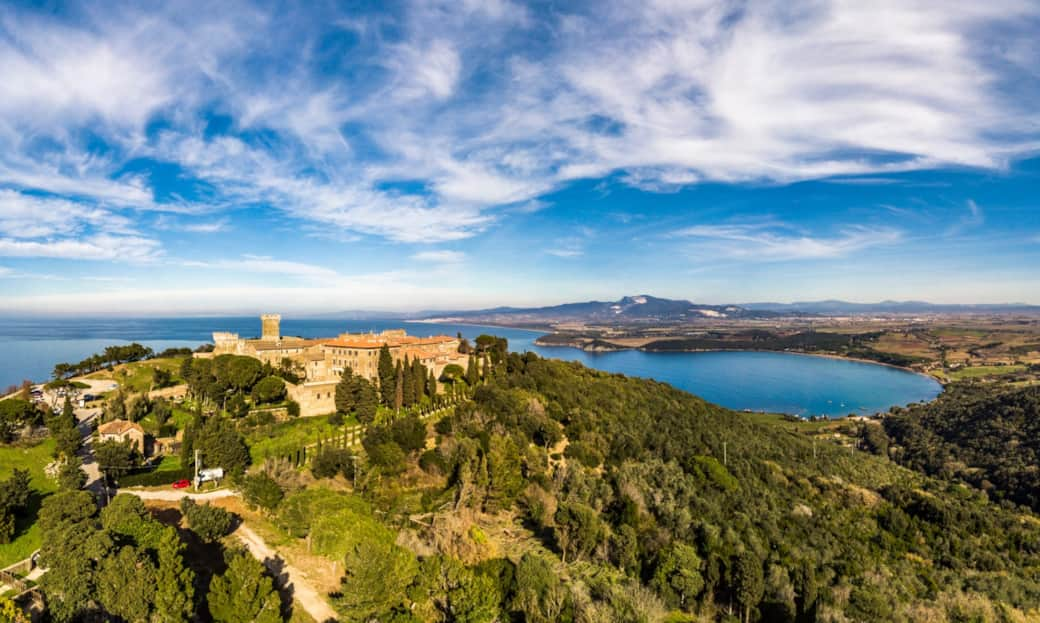
Perched on the top of a hill overlooking the surrounding countryside and the sea, this charming medieval village developed around the Castello dei Della Gherardesca, built around the year 1000.
The village features cobblestone alleys, natural terraces with views over the sea and countryside, harmonious squares, ancient artisan workshops, and characteristic trattorias.
There are significant historical landmarks, such as the Palazzo Pretorio—now the Town Hall—and the churches of San Lorenzo and SS. Crocifisso, the latter known for its 15th-century wooden crucifix.
Originally called Castagneto Marittimo, the town changed its name in the early 20th century in honor of the great poet Giosuè Carducci, who spent part of his life here. The house where Carducci lived now hosts a museum filled with memorabilia.
BOLGHERI
Bolgheri sits on a small rise at the end of the famous cypress-lined avenue that begins in San Guido; all around, the village is surrounded by woods rich in typical Mediterranean vegetation and by well-cultivated plains.
It is connected to Castagneto—of which it is a hamlet—by the Via Bolgherese, a splendid road now known as the “Wine Road” because of the prestigious wines produced in this area.
The ancient medieval village is accessed by passing through the monumental arch of the castle.
Inside, along the narrow alleys and small squares that evoke the atmosphere of bygone times, you’ll find small “botteghe,” where typical local products can still be found and where you can enjoy simple traditional specialties.
Between 1838 and 1848, Bolgheri hosted Giosuè Carducci, who, with his verses, helped make Bolgheri and its surroundings known throughout the world.
MARINA DI CASTAGNETO
Overlooking a long stretch of golden coastline, Marina di Castagneto Carducci is a seaside destination with true Mediterranean charm, loved for its wide, clean beaches—perfect for families and sports enthusiasts. Here, the crystal-clear sea meets a lush, centuries-old pine forest, ideal for shaded walks and moments of relaxation immersed in nature.
The area offers numerous attractions, including well-equipped beach clubs, seaside restaurants, cycling paths, and the famous amusement park Cavallino Matto, one of the largest in Tuscany, providing fun-filled days for both adults and children. At sunset, the seafront promenade comes alive with colors and scents, creating a vibrant and welcoming atmosphere that carries into the evening with music, markets, and beachside venues.
SUVERETO
Considerato uno dei borghi più belli della Toscana, Suvereto è un piccolo capolavoro medievale incastonato tra colline verdi e vigneti. Varcando la sua antica porta d’ingresso ci si ritrova in un intreccio di vicoli in pietra, archi, piazzette e case curate con amore, un luogo dove il tempo sembra scorrere più lentamente.
Il borgo è celebre per la sua tradizione enogastronomica: cantine storiche, produzioni d’eccellenza e trattorie tipiche raccontano la ricchezza di un territorio votato ai grandi vini e ai sapori autentici. Da visitare il Palazzo Comunale, la Rocca Aldobrandesca e i suggestivi percorsi che si snodano tra ulivi e boschi di sughere – da cui il paese prende il nome.
Suvereto è un luogo che conquista con la sua eleganza semplice, la sua storia ancora viva e l’atmosfera calda e genuina dei suoi abitanti.